Year: 2013

Life in Libya: The good, the bad and the ugly

Don’t believe everything you read, the old adage goes. In the case of post-revolution Libya, that cannot be truer. Dramatic headlines of civil war, chaos and a failed state are just that: dramatic. I know this to be the case because in a series of crazy and adventurous events, I left my comfortable western life to see how I could make a change in my ancestral homeland.

Since 2004 I’ve been coming to Libya for short summer visits. My father left the country in the late 70s in open and active opposition to the Gaddafi regime, so we weren’t raised with extended family. I enjoyed getting to know them during these trips.

But after two months of North African hospitality, I could not wait to get back to my convenient and consumerist lifestyle in the States. It was a novelty to pick fresh almonds, use tree branches to sweep the floor and milk goats, but I kept thinking about what I would do the moment I was home: get a pedicure and make a Taco Bell run.

Something changed in the summer of 2012. I came to post-revolution Libya and fell in love. It wasn’t with a handsome boy with a dashing smile. It wasn’t a summer fling. I fell in love with the revolution street art; with children making the peace sign as they hung out of car windows; with the protests of people unhappy with the government; with the billboards memorialising our fallen heroes. I fell in the love with the excitement, freedom, and carefree feeling in the air. I fell in love with Libya. And for the first time, I actually imagined moving here.
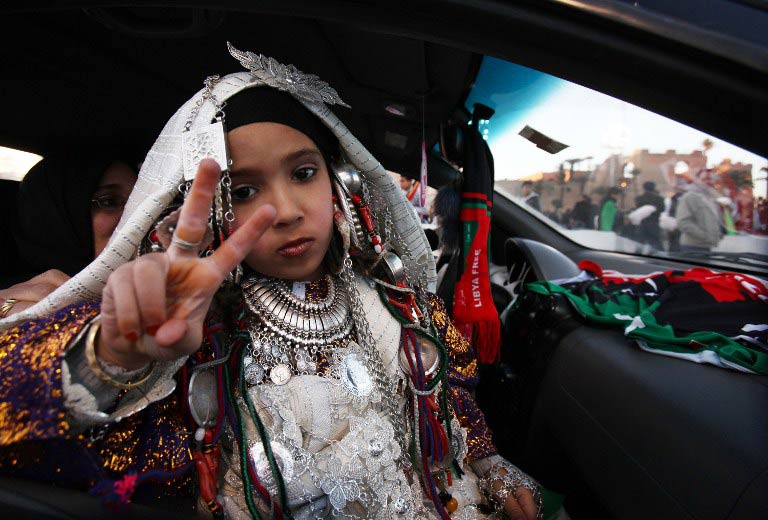
A Libyan girl in traditional tribal costume flashes the V-sign for victory as families parade in their cars through the streets of Tripoli in celebration on February 16 2012, the eve of the first anniversary of the revolt against Muammar Gaddafi. (AFP)

My decision shocked me and everyone who knew me. I am a Walmart-going, interstate-driving, ridiculously large-sized diet-Coke-drinking, Kentucky Basketball-supporting, rap music-listening, preamble-memorising American. I’m the product of the American Dream, of immigrant parents who fled their homeland to give their children freedom, education and a bright future, yet I grew up with a deep-rooted love for Libya. Of course, the promises of “going home” once Gaddafi died or was overthrown were repeated continuously in our home but I didn’t give it much thought. I was just a kid then. Later, I figured that this tyrant wasn’t going anywhere after 40 years and I wasn’t inclined to give up Netflix even if he did. So when I came to Libya last year, fell in love and found a job that would keep me here, it took a small push and a big leap of faith to say yes.

I’ve been in Tripoli for almost seven months now and, as with all situations, I’ve found the good, the bad and the ugly. The good: I no longer worry about gas prices. At a cool 15 Libyan cents per litre, I can fill up my car for the equivalent of 3.75 US dollars. The bad: Because fuel is so cheap, everyone is on the roads and there’s always traffic. The ugly: There are no traffic laws here so if someone hits you, odds are you’re not going to be compensated.

Living in Libya has made me more flexible. There are no one-stop shops with all my needs. I might not find brown sugar and people will cut in line at check-out, but gentlemen rush to help with heavy items or insist on loading my groceries. I’ve realised how much of superfluous stuff there was in my life – who needs a mini pocket iron? I have become Libya’s pioneer woman. If I want Mexican food, I hunt down avocados, I make sour cream, and I chop my tomatoes for salsa. It’s been in a lesson in humility and character-building.

I’ve also realised how very normal my life here is. I wake up in the morning, brew my coffee, sit in traffic yelling at the idiot in front of me, get to my office and rush in, pretending I’m not late. I help my customers, reply to email requests, laugh with coworkers at the water cooler, and come home exhausted. I eat dinner with my feet up on the couch and hit the sack – only to do it all again the next day. True, my social life isn’t what it used to be – there isn’t a cinema or big shopping malls. I spend Friday nights at local cafés with friends, enjoying  great conversation, strong espresso and Tripoli’s latest craze: Cinnabon. I have beach days on the beautiful Mediterranean shore and I can tell you where the best Indian food in all of Libya is.
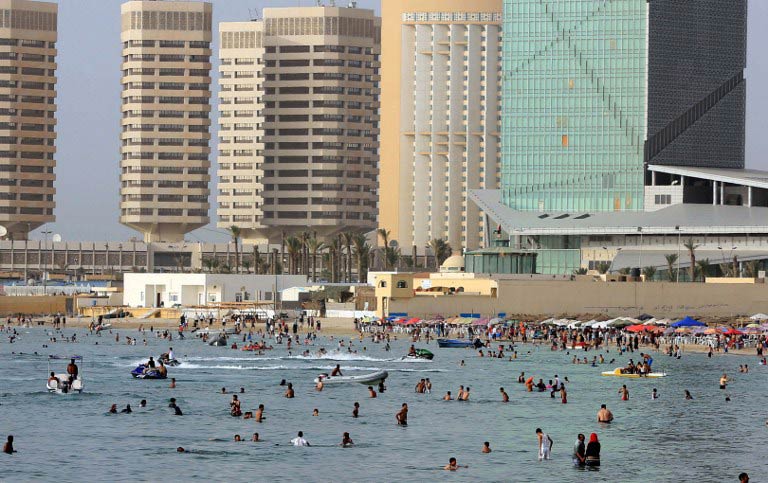
Libyans cool off at the seaside with the onset of summer and high temperatures in Tripoli on June 9 2013. (AFP)
Libyans cool off at the seaside on June 9 2013. (AFP)

Yes, I may hear the occasional 14.5mm round go off, but it has become my Libyan white noise. Life in Libya is carrying on, it’s business as usual. Bakeries are filled with delicious soft bread, cafés buzz with their loyal caffeine- and nicotine-addicted patrons, vegetable stands are filled and shopkeepers are bringing in the latest styles (skinny jeans and flats are all the rage). There isn’t a week that goes by when I don’t stand back and say: “I can’t believe this is Libya.”

Articles and analyses by “experts” portray Libya on a broken, dangerous, and dead-end path. But these writers are not here. They don’t see kids running happily to school with new books and uniforms. They don’t see the policemen who’ve just recently graduated guarding our neighborhoods. They don’t discuss the grassroots initiatives that clean up the streets.

Libya might make my OCD tendencies flare up and stores may not have my favorite balsamic dressing, but this country has given me an opportunity to grow personally and professionally. It’s the land of my father and the place I now call home.

Assia Amry is a Libyan-American and a graduate of political science and international relations. She currently lives in Tripoli. Follow her on Twitter.
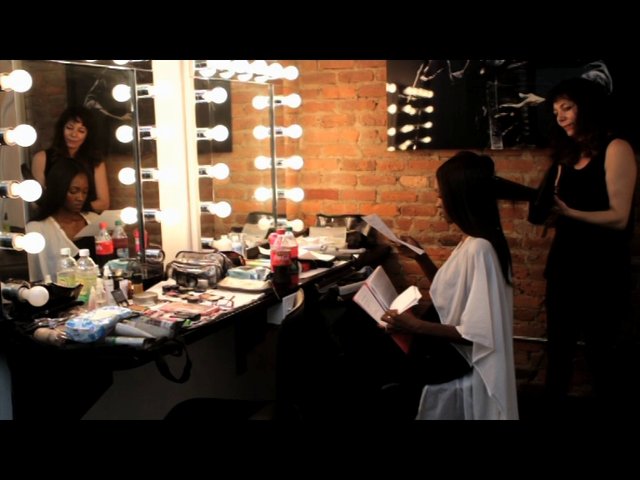
In search of Africa’s next catwalk queen

Inspired by Tyra Banks’ America’s Next Top Model, Africa’s Next Top Model is a new reality TV contest in search of the continent’s next Iman, Alek Wek or Oluchi Orlandi. It will be shot on location in South Africa, with Nigerian supermodel Orlandi hosting and producing it.

Twelve aspiring models will be chosen during auditions to compete for the top prize – a coveted modelling contract. They’ll spend several weeks living together, receiving fashion training and being judged on weekly challenges. Auditions open soon in Angola, Ghana, Ivory Coast, Kenya, Mozambique, Nigeria, South Africa and Tanzania and the series will be broadcast on M-Net Africa Magic channels later this year.

A hip-hop-loving hacker on an Islamic mission

In Nouakchott, a dusty city wedged between the Atlantic ocean and western dunes of the Sahara, a young hip-hop fan co-ordinates a diverse group of hackers targeting websites worldwide in the name of Islam.

Logging on to his computer, he greets his Facebook fans with a “good morning all” in English before posting links to 746 websites they have hacked in the last 48 hours along with his digital calling card: a half-skull, half-cyborg Guy Fawkes mask.

He calls himself Mauritania Attacker, after the remote Islamic republic in West Africa from which he leads a youthful group scattered across the Maghreb, southeast Asia and the West.

The Mauritania Attacker's Facebook profile pic.
The Mauritania Attacker’s current profile picture on Facebook.

As jihadists battle regional governments from the deserts of southern Algeria to the scrubland of north Nigeria, Mauritania Attacker says the hacking collective which he founded, AnonGhost, is fighting for Islam using peaceful means.

“We’re not extremists,” he said, via a Facebook account which a cyber security expert identified as his. “AnonGhost is a team that hacks for a cause. We defend the dignity of Muslims.”

During a series of conversations via Facebook, the 23-year-old spoke of his love of house music and hip-hop, and the aims of his collective, whose targets have included US and British small businesses and the oil industry.

He represents a new generation of western-style Islamists who promote religious conservatism and traditional values, and oppose those they see as backing Zionism and Western hegemony.

An unlikely hacker base
In April, AnonGhost launched a cyber attack dubbed OpIsrael that disrupted access to several Israeli government websites, attracting the attention of security experts worldwide.

“AnonGhost is considered one of the most active groups of hacktivists of the first quarter of 2013,” said Pierluigi Paganini, security analyst and editor of Cyber Defense magazine.

An online archive of hacked websites, Hack DB, lists more than 10 400 domains AnonGhost defaced in the past seven months.

Mauritania, a poor desert nation straddling the Arab Maghreb and sub-Saharan Africa, is an unlikely hacker base. It has 3.5 million inhabitants spread across an area the size of France and Germany, and only 3% of them have internet access.

Much of the population lives in the capital Nouakchott, which has boomed from a town of less than 10 000 people 40 years ago to a sprawling, ramshackle city of a million inhabitants. In its suburbs, tin and cinder-block shanties battle the Sahara’s encroaching dunes and desert nomads stop to water their camels.

In the past six months experts have noted an increase in hacking activity from Mauritania and neighbouring countries. In part, that reflects Mauritania Attacker’s role in connecting pockets of hackers, said Carl Herberger, vice-president of security solutions at Radware.

“This one figure, Mauritania Attacker, is kind a figure who brings many of these groups together,” Herberger told Reuters.

Modern technology, ancient mission
Mauritania Attacker says his activities are split between cyber cafes and his home, punctuated by the five daily Muslim prayers.

Well-educated, he speaks French and Arabic among other languages and updates his social media accounts regularly with details of the latest defacements and email hacks. He would not say how he made a living.

His cyber threats are often accented with smiley faces and programmer slang, and he posts links to dance-floor hits and amusing YouTube videos. But his message is a centuries-old Islamist call for return to religious purity.

“Today Islam is divisive and corrupt,” he said in an online exchange. “We have abandoned the Qur’an.”

Mauritania Attacker aims to promote “correct Islam” by striking at servers hosted by countries they see as hostile to Sharia law. “There is no Islam without Sharia,” he said.

Mauritania is renowned for its strict Islamic law. The sale of alcohol is forbidden and it is one of only a handful of states where homosexuality and atheism are punished by death.

The quality of Mauritania’s religious scholars and Quranic schools, or madrassas, attract students from around the world. Mauritanians have risen to prominent positions in regional jihadist groups, including al-Qaeda’s north African branch Aqim.

As hackers from the region organise into groups, the Maghreb is emerging as a haven for hacktivism as it lacks the laws and means to prosecute cyber criminals, Herberger said.

“There’s a great degree of anonymity and there’s a great degree of implied impunity,” he said.

Security sources in Nouakchott said they were not aware of the activities of Mauritania Attacker.

He says he supports Islamists in Mauritania but opposes his government’s support for the West, which sees the country as one of its main allies in its fight against al-Qaeda in the region.

With tech-savy young Muslims in the Maghreb chafing under repressive regimes, analysts anticipate a rise in hacktivism.

Hacking is a way for young people to express religious and political views without being censored, says Aaron Zelin, a Washington Institute fellow.

“These societies are relatively closed in terms of people’s ability to openly discuss topics that are taboo,” he said.

For disillusioned youth in countries like Mauritania, where General Mohamed Ould Abdel Aziz seized power in a 2008 coup before winning elections the next year, hacking has become “a way of expressing their distaste with status quo,” Zelin said.

Capability
AnonGhost’s global reach is its greatest weapon, but it has yet to stage a major attack on a western economic target.

Most of AnonGhost’s campaigns have simply defaced websites, ranging from kosher dieting sites to American weapon aficionado blogs, with messages about Islam and anti-Zionism.

It has attacked servers, often hosting small business websites, located in the United States, Brazil, France, Israel and Germany among others.

Mauritania Attacker and the AnonGhost crew say these countries have “betrayed Muslims” by supporting Israel and by participating in the wars in Afghanistan and Iraq.

“We are the new generation of Muslims and we are not stupid,” read a message posted on the website of a party supply business in Italy. “We represent Islam. We fight together. We stand together. We die together.”

The team has also leaked email credentials, some belonging to government workers from the United States and elsewhere.

As part of a June 20 operation against the oil industry, carried out alongside the international hacking network Anonymous, Mauritania Attacker released what he said were the email addresses and passwords for employees of Total.

A spokesperson for the French oil major did not immediately respond to requests for comment.

One security expert said AnonGhost’s attacks exploited “well-known vulnerabilities in configurations of servers” in target countries rather than going after high-profile companies.

Carl Herberger, vice-president of security solutions at Radware, remains unconvinced AnonGhost has the technical skills to wage full-scale cyber terrorism by harming operational capabilities of companies or government agencies.

“The jury is still out,” he said, but cautioned against underestimating the emerging group. “You’re never quite sure what they’re going to do on the offensive, so they have to be right only once and you have to be right always.”

Elise Knutsen for Reuters

Mandela the boxer inspires Soweto gym-goers

In a sweaty township gym where Nelson Mandela once trained as a young boxer, athletes are still pumping iron today, inspired by the peace icon’s example as he fights for his life in hospital.

In the early 1950s, a youthful Mandela worked out on week nights at the Donaldson Orlando Community Centre, or the “D.O.” as it’s still affectionately known.

Spartan and slightly run down, the walls ooze with the intermingled history of sport, community life and the decades-long fight against apartheid oppression.

It was here that Mandela came to lose himself in sport to take his mind off liberation politics.

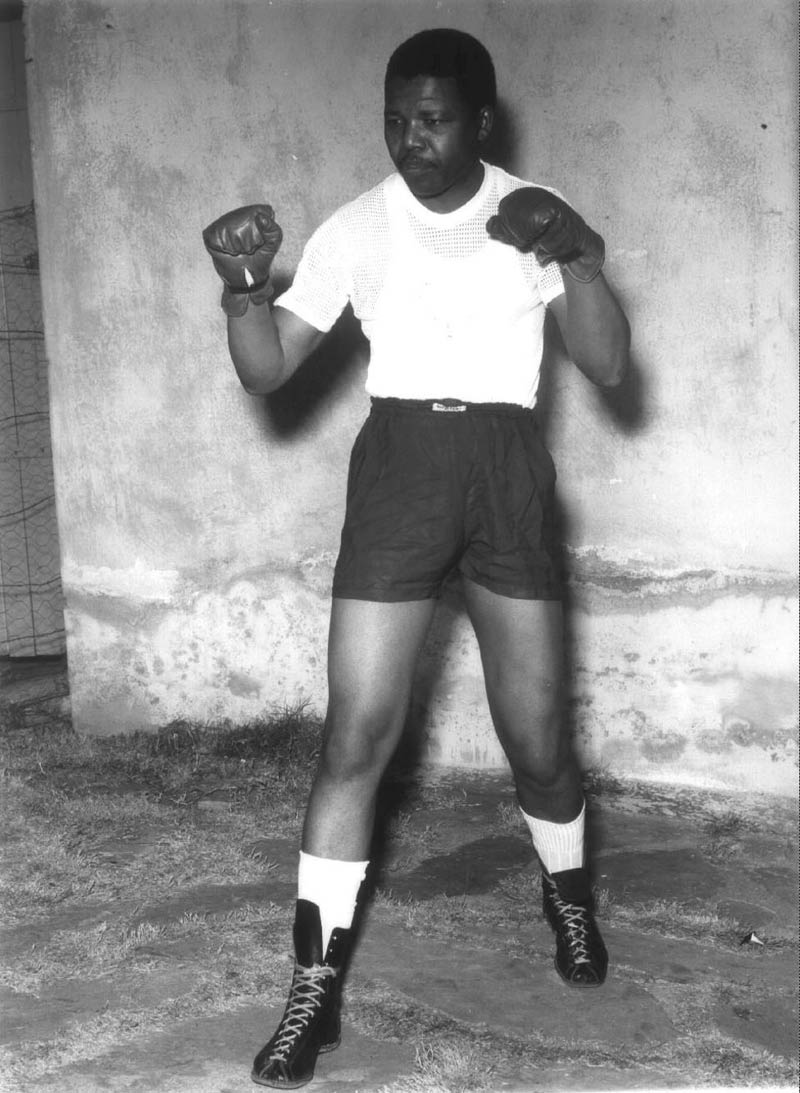
A young Nelson Mandela in boxing gear. (Gallo)

Nestled in the heart of South Africa’s largest township just south of Johannesburg, the community centre was also where famous African songbirds like Miriam Makeba and Brenda Fassie first performed.

The 1976 uprising against the imposition of the Afrikaans language in black schools were planned from the D.O. as Mandela and other leaders languished in apartheid jails.

“Here, look, these are the very same weights Madiba used for training,” proud gym instructor Sinki Langa (49) says.

“They have lasted all these years,” he said as he added another set to a bar his fellow trainee Simon Mzizi (30) was using to furiously bench-press, sweat dripping down his face.

Nearby, other fitness enthusiasts worked out to the tune of soothing music which, unusually for a gym, included opera.

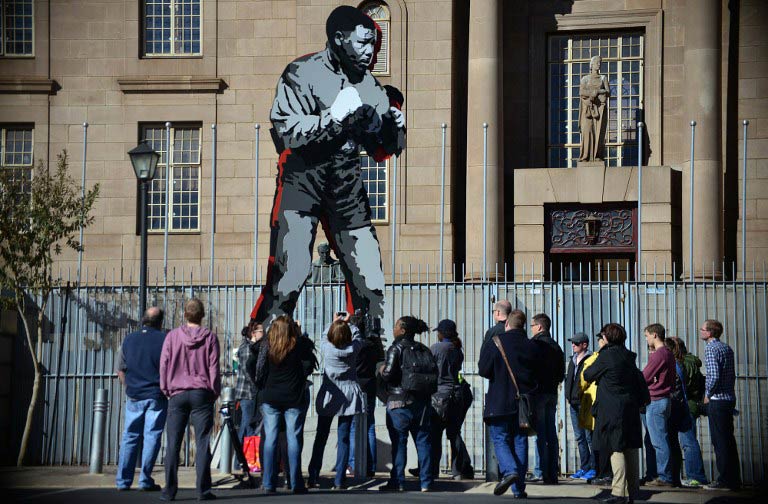
The six metre-high 'Shadow Boxer' sculpture in Johannesburg's inner city depicts Nelson Mandela as a young boxer. (AFP)
The 6m-high ‘Shadow Boxer’ sculpture in Johannesburg’s inner city was unveiled in honour of Nelson Mandela in May 2013. (AFP)

‘Drenched with sweet memories’
The D.O. – or Soweto YMCA as it is called today – opened its doors in 1948, the same year the apartheid white nationalist government came to power.

Built with funds donated by Colonel James Donaldson, a self-made entrepreneur and staunch supporter of the now governing African National Congress, the D.O. centre includes a hall, and several sparsely furnished smaller rooms like the one where Mandela sparred as a young man.

Today the gym is housed in an adjacent hall, which was the original building on the grounds erected in 1932.

Mandela joined the D.O. in around 1950, often taking his oldest 10-year-old son Thembi with him.

In a letter to his daughter Zinzi, while on Robben Island where he spent 18 of his 27 years in jail, Mandela recalled his days at the gym.

“The walls … of the DOCC are drenched with the sweet memories that will delight me for years,” he wrote in the letter, published in his 2010 book Conversations with Myself.

“When we trained in the early 50s the club included amateur and professional boxers as well as wrestlers,” Mandela wrote to his daughter, who never received the letter because it was snatched by his jailers.

Training at the D.O. was tough and included sparring, weight-lifting, road-running and push-ups.

“We used to train for four days, from Monday to Thursday and then break off,” Mandela told journalist Richard Stengel in the early 1990s, while writing his autobiography Long Walk to Freedom.

When he was handed a life sentence in 1964, Mandela kept up the harsh regime of his training to stay fit and healthy.

“I was very fit, and in prison, I felt very fit indeed. So I used to train in prison … just as I did outside,” Mandela said in a transcript of his conversation with Stengel, given to AFP by the Nelson Mandela Centre of Memory.

Mandela was eventually released from jail in 1990 and in 1994 he was elected South Africa’s first black president.

‘He’s a fighter’
In Long Walk to Freedom, Mandela admitted he was “never an outstanding boxer”.

“I did not enjoy the violence of boxing as much as the science of it… It was a way of losing myself in something that was not the struggle,” Mandela wrote.

“Back in those days, boxing was very popular – it was part of that culture,” Shakes Tshabalala (81) who has been involved with the centre from the start told AFP.

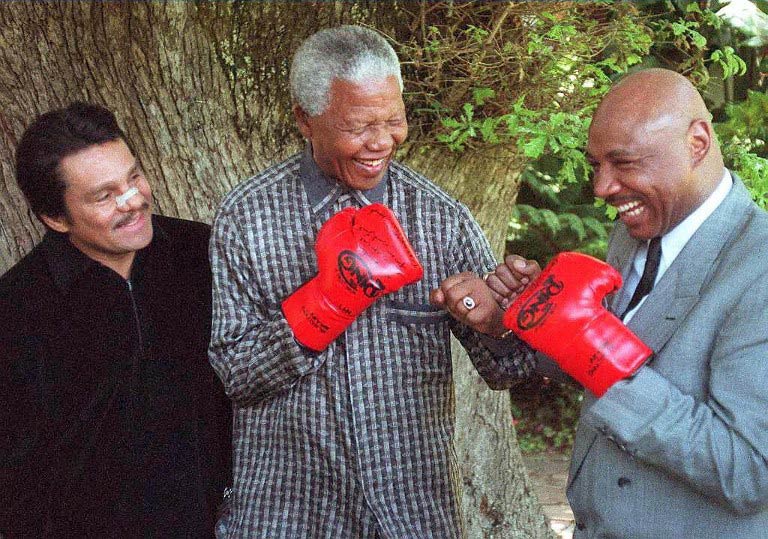
Nelson Mandela (C) pretends to fight former US world middleweight champion Marvin Hagler (R) in Cape Town on November 12 1997 while former five-time world champion Roberto "Hands of Stone" Duran (L) of the US looks on. (AFP)
Nelson Mandela (C) pretends to fight former US world middleweight champion Marvin Hagler (R) in Cape Town on November 12 1997 while former five-time world champion Roberto “Hands of Stone” Duran (L) of the US looks on. (AFP)

Pugilism always played a big part in Mandela’s life. At his house-turned-museum at 8115 Orlando West, boxing-related items like the WBC World Championship belt donated by Sugar Ray Leonard are on display.

Back at the centre, a new generation of youngsters are training.

Although few of them box today, they draw their inspiration from Mandela’s example in healthy living.

While the ailing 94-year-old statesman is battling a recurring lung infection, the gym-goers firmly believe the liberation icon will return for one last round.

“Mandela was a sportsman. This is why today he is still alive,” said gym instructor Langa.

“I am worried about him, but I know he’ll win. He’s a fighter,” he said.

Jan Hennop for AFP

Facebook courting, Mogadishu-style

A tall figure in a black hijab and face veil strides confidently towards 20-year-old Ahmed Noor’s computer terminal. Only her dark brown eyes and eyelashes, thick with mascara, are visible.

On reaching Noor, she lifts her hijab to reveal manicured nails and gold rings on her fingers. In her hand she’s holding a folded white piece of paper. With a wink she passes it to Noor and walks off into the busy street outside.

Noor unfolds the paper. There’s a Facebook profile link and an email address written on it. It’s now up to him to take the next step.

This is post civil-war courting, Mogadishu-style.

In the conservative Muslim society, social networking is a popular and easy way through which Somalis can interact with members of the opposite sex.

Slow internet speeds – fibre optic cables are yet to reach us – and expensive internet café rates of up to 60 US cents per hour do not deter Somalis from staying connected. Internet penetration in the country is only at about 2% but it’s growing, especially among the youth. Currently there are more than 130 000 Facebook users in Somalia and more than half of them are between the ages of 18 and 24.

Despite the hardline al-Shabab group no longer controlling the Somali capital and imposing its own version of Sharia law, many women still wear the face veil. The only place their faces are visible is on their Facebook profiles. Even then, they’re a step ahead in concealing their real identity thanks to photo-editing software.

“Many girls come to us to have their photos altered. We exchange, for example, the head of an actress with theirs so the picture has their face on an actress’s body,” says Sharif Hussein (24) who runs Satellite Photo Studio. It’s conveniently located next to an internet café.

“They usually tell me they want me to photoshop their pictures so they can send it to potential boyfriends or husbands on Facebook.”

Some university students and working professionals prefer studio shoots instead of what Hussein calls a ‘virtual body part swap’. They stop at the Mogadishu Beauty Salon a short drive away to have their hair and make-up done professionally before arriving at his studio.

Saida Ahmed, a colourful woman in both appearance and personality, runs the popular beauty salon. She’s wearing a bright orange dress, her hair is dyed orange with henna and her ear lobes stretch under the weight of gold earrings.

“Some girls come here black and want to look white, so I make sure they leave the salon white. I’m here to help other sisters succeed with their Facebook missions,” she tells me while applying cream on a client’s face.

(Graphic: Kenny Leung, M&G)

But Somali guys aren’t impressed with the visual tricks girls are employing on Facebook. “They look like Iman [the Somali supermodel] on their Facebook profile and they sound like Farxiya Fiska a [popular female singer] on the phone, but in reality they are neither,” complains Noor.

Back at the internet café where I’m hanging out with him and his friends, all the females are wearing face veils. One of them, Amina (19), is chatting on Facebook and showing off her two Chinese-made smart phones to friends over a webcam.

I ask her about Somali women’s preference for digitally enhanced photos and she retorts that Somali men shouldn’t complain.

“Men in Mogadishu tell lies to your face, we at least tell it behind a screen. They have two, three, four wives and still tell you they are single,” she says, breaking into high-pitched laughter.

Her friend Shamsa calls me over to her terminal and shows me her Facebook friends list. Most of the men on it look more like Arnold Schwarzenegger than typical Somalis.

“Guys do the same thing that we do! And worse,” Shamsa points out, clicking through the men’s photos. “They all look like wrestlers. You will not find a skinny Somali man on Facebook. They don’t look like Mo Farah.”

Hussein concurs with Shamsa and admits to helping many men doctor their photos. “Plenty of them come to my studio too. They usually ask me to swap their torsos with those of bodybuilders.”

With these tricks up their sleeves, courting on Facebook can be entertaining and exciting but religious leaders in Mogadishu aren’t happy about it. Sheikh Abdi Haji, a religious studies lecturer at Mogadishu University and imam of Zobe Mosque is vocal in his opposition to youngsters searching for life partners on the social network.

“There is a guy who wanted to marry a lady he met on Facebook. He paid the dowry only to find out on the wedding night she is a cripple. She didn’t tell him before they got married, nor did the pictures on her Facebook show she is a cripple.” Youth should stay away from Facebook, Sheikh Abdi says, because it’s full of “hypocrites”.

Noor, Amina and Shamsa wouldn’t reveal whether flirting on Facebook has paid off for them. They, like other young Somalis, are ever wary of the “religious police” and prefer to keep their relationships quiet to avoid trouble. There’s no way they’ll give up Facebook, though.

Noor takes out the piece of paper that the mysterious young woman had handed to him earlier. He’s going to take the next step. And, he tells me quietly, he’s come up with a solution to avoid being duped by Somali ‘supermodels’.

“I don’t go for girls with very pretty profile photos. They’re photoshopped. If she’s average-looking with spots on her face, I talk to her.”

Hamza Mohamed is an independent Britishi-Somali journalist. Connect with him on Twitter